


“He awoke to the sound of water
dripping into a rusted sink. The streets below were bathed in medieval
moonlight, reverberating silence. He lay there grappling with the terror of
beauty, as the night unfolded like a Chinese screen. He lay shuddering, riveted
by flickering movements of aliens and angels as the words and melodies of
“Marquee Moon” were formed, drop by drop, note by note, from a state of calm
yet sinister excitement. He was Tom Verlaine, and that was his process:
exquisite torment.
Born Thomas Joseph Miller, raised
in Wilmington, Delaware, he left his parental home and shed his name, a
discarded skin curled in the corner of a modest garage among stacks of used
air-conditioners that required his father’s constant professional attention.
There were hockey sticks and a bicycle and piles of Tom’s old newspapers strewn
in the back, covered with ghostly outlines of distorted objects; he would run
over tin cans until they were flattened, barely recognizable, and then spray
them with gold, his two-dimensional sculptures, each representing a rapturous
musical phrase. In high school, he played the saxophone, embracing and
Albert Ayler. He played hockey, too, and when a flying puck knocked out his
front teeth he was obliged to put away his saxophone and dedicate himself to
the electric guitar.
He lived twenty-eight minutes from
where I was raised. We could easily have sauntered into the same Wawa on the
Wilmington-South Jersey border in search of Yoo-hoo or Tastykakes. We might
have met, two black sheep, on some rural stretch, each carrying books of the
poetry of French Symbolists—but we didn’t. Not until 1973, on East Tenth
Street, across from St. Mark’s Church, where he stopped me and said, “You’re
Smith.” He had long hair, and we clocked each other, both echoing the future,
both wearing clothes they didn’t wear anymore. I noticed the way his long arms
hung, and his equally long and beautiful hands, and then we went our separate
ways. That was, until Easter night, April 14, 1974. Lenny Kaye and I took a
rare taxi ride from the Ziegfeld Theatre after seeing the première of “Ladies
and Gentlemen: The Rolling Stones,” straight down to the Bowery to see a new
band called Television.
The club was CBGB. There were only
a handful of people present, but Lenny and I were immediately taken with it,
with its pool table and narrow bar and low stage. What we saw that night was
kin, our future, a perfect merging of poetry and rock and roll. As I watched
Tom play, I thought, Had I been a boy, I would’ve been him.
I went to see Television whenever
they played, mostly to see Tom, with his pale blue eyes and swanlike neck. He
bowed his head, gripping his Jazzmaster, releasing billowing clouds, strange
alleyways populated with tiny men, a murder of crows, and the cries of
bluebirds rushing through a replica of space. All transmuted through his long
fingers, all but strangling the neck of his guitar.
Through the coming weeks, we drew
closer. As we walked the city streets, we would improvise ongoing tales, our
own “Arabian Nights.” We discovered that we both loved the work of the Armenian
American composer Alan Hovhaness, our favorite work being “Prayer of St.
Gregory.” Examining each other’s bookcases, we were amazed to find that our
books were nearly identical, even those by authors difficult to find. Cossery,
Hedayat, Tutuola, Mrabet. We were both independent literary scouts, and we came
to share our secret sources.
He devoured poetry and
dark-chocolate-covered Entenmann’s doughnuts, downed with coffee and cigarettes.
Sometimes he would seem dreamy and faraway then suddenly break into peals of
laughter. He was angelic yet slightly demonic, a cartoon character with the
grace of a dervish. I knew him then. We liked holding hands and spending hours
browsing the shelves of Flying Saucer News and going to Forty-eighth Street and
looking at guitars that he could never afford and riding the Staten Island
Ferry after three sets at CBGB and climbing six flights of stairs to the
apartment on East Eleventh Street and lying together on a mattress gazing at
the ceiling and listening to the rain and hearing something else.
There was no one like Tom. He
possessed the child’s gift of transforming a drop of water into a poem that
somehow begat music. In his last days, he had the selfless support of devoted
friends. Having no children, he welcomed the love he received from my daughter,
Jesse, and my son, Jackson.
In his final hours, watching him
sleep, I travelled backward in time. We were in the apartment, and he cut my
hair, and some pieces stuck out this way and that, so he called me Winghead. In
the years to follow, simply Wing. Even when we got older, always Wing. And he,
the boy who never grew up, aloft the Omega, a golden filament in the vibrant
violet light.”
( Patti Smith, fonte “The
New York Times” )


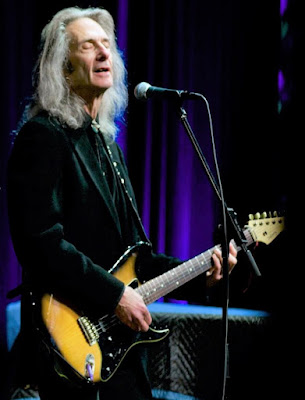
“Recording sessions in Hawai dilute Quicksilver’s
(Messenger Service) essence and motivation, and Cipollina begins to seem a
distraction rather than a linchpin of their sound. He leaves the band in
October 1970, on the same night at Winterland thar Marty Balin departs
Airplane, and news of Janis Joplin’s death reaches the stunned audience, an
epitaph for the San Francisco Sound in the making. John’s renown is such that
the Welsh group Man flies him to the London Roundhouse in May 1975 to replicate
his bar shivers for a live album. True to form, he is out of tune, as if tuning
matters in his moving target of temperament . He is my favorite guitarrist.
What more can I say?” ( Lenny Kaye
in “Lightning Striking” )
Após ter lido estas linhas no recém publicado livro de Lenny
Kaye, a admiração que já dedicava ao braço direito de Patti Smith, ao artista e
ao crítico, cresceu exponencialmente. Um privilégio que humildemente dedico a
todos os que, como o Atalho, não prescindem do legado de John Cipollina.
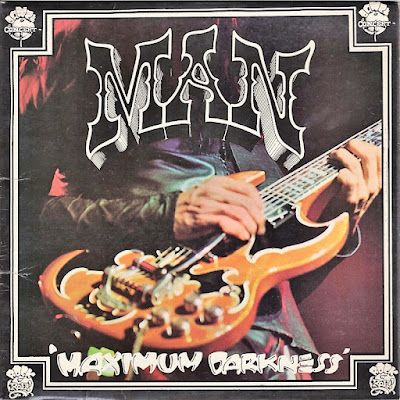
E foi um prazer inesperado voltar a “Maximum Darkness”, o
resultado da actuação no Roundhouse a 26 de Maio de 75. Dois guitarristas
virtuosos; num dos lados Micky Jones, no outro Deke Leonard e ao meio, ao meio,
aquele vibrato, aquele som inimitável e irrepetível que tornou Cipollina lendário.
Não será seguramente o melhor álbum dos galeses e Cipollina já não serpenteava
por “Codine” como outrora, mas representa um testemunho de inegável valor artístico
e histórico, o momento único em que três enormes guitarristas partilharam o
mesmo palco em simultâneo. No final, de regresso ao presente, a desagradável
sensação de saber que nenhum dos três já se encontra entre nós.
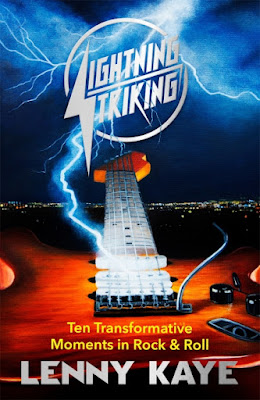
A boa notícia é que “Lightning Striking” pode ser lido por etapas, épocas ou,
se quisermos, por movimentos e estilos musicais, uma vez que a organização dos
capítulos isso permite. A saber: Cleveland 1952 / Memphis 1954 / New Orleans
1957 / Philapdelphia 1959 / Liverpool 1962 / San Francisco 1967 / Detroit 1969
/ New York City 1975 / London 1977 / Los Angeles 1984, Norway 1993 / Seattle
1991.
Terão ficado algumas pedras por virar. Desde logo o movimento
folk britânico dos 70s ou o período áureo dos singer songwriters, mas essas, tal como o sub-título do livro induz, não
serão as praias favoritas de Lenny Kaye.


Reencontrei este pedaço de história, captado pela objectiva de Bob Gruen, quando abri uma velha pasta repleta de fotos de que já não me recordava. O que eu teria pago para estar perto do palco do Ocean Club em Nova Iorque naquele 21 de Julho de 76…
Uma noite em que John Cale, Patti Smith, Lou Reed e David Byrne, se auto-denominavam “The Loft Dwellers” e, consta, receberam a ajuda dos “irrelevantes” Chris Spedding, Alan Lanier e Mick Ronson.
Para além de um “bootleg” – “John Cale & Friends at The Ocean Club, July 1976” -, cuja qualidade áudio repele mais do que cativa, não há notícia de que algo de mais substancial tenha emergido dos ensaios/sessões. Uma pena.

But no you gotta, you gotta [relate, babe,]
You gotta find the rhythm within
Floor boss slides up to me and he says
"Hey sister, you just movin' too fast,
You screwin' up the quota,
You doin' your piece work too fast,
Now you get off your mustang sally
You ain't goin' nowhere, you ain't goin' nowhere."
I lay back. I get my nerve up. I take a swig of Romilar
And walk up to hot shit Dot Hook and I say
"Hey, hey sister it don't matter whether I do labor fast or slow,
There's always more labor after."
She's real Catholic, see. She fingers her cross and she says
"There's one reason. There's one reason.
You do it my way or I push your face in.
We knee you in the john if you don't get off your get off your mustang Sally,
If you don't shake it up baby." Shake it up, baby. Twist & shout"
Oh that I could will a radio here. James Brown singing
"I Lost Someone" or the Jesters and the Paragons
And Georgie Woods the guy with the goods and Guided Missiles ...
But no, I got nothin', no diversion, no window,
Nothing here but a porthole in the plaster, in the plaster,
Where I look down, look at sweet Theresa's convent
All those nurses, all those nuns scattin' 'round
With their bloom hoods like cats in mourning.
Oh to me they, you know, to me they look pretty damn free down there
Down there not having crystal smooth
Not having to smooth those hands against hot steel
Not having to worry about the [inspeed] the dogma the [inspeed] of labor
They look pretty damn free down there,
And the way they smell, the way they smell
And here I gotta be up here smellin' Dot Hook's midwife sweat
I would rather smell the way boys smell--
Oh those schoolboys the way their legs flap under the desks in study hall
That odor rising roses and ammonia
And way their dicks droop like lilacs
Or the way they smell that forbidden acrid smell
But no I got, I got pink clammy lady in my nostril
Her against the wheel me against the wheel
Oh slow motion inspection is drivin' me insane
In steel next to Dot Hook -- oh we may look the same--
Shoulder to shoulder sweatin' 110 degrees
But I will never faint, I will never faint
They laugh and they expect me to faint but I will never faint
I refuse to lose, I refuse to fall down
Because you see it's the monotony that's got to me
Every afternoon like the last one
Every afternoon like a rerun next to Dot Hook
And yeah we look the same
Both pumpin' steel, both sweatin'
But you know she got nothin' to hide
And I got something to hide here called desire
I got something to hide here called desire
And I will get out of here--
You know the fiery potion is just about to come
In my nose is the taste of sugar
And I got nothin' to hide here save desire
And I'm gonna go, I'm gonna get out of here
I'm gonna get out of here, I'm gonna get on that train,
I'm gonna go on that train and go to New York City
I'm gonna be somebody, I'm gonna get on that train, go to New York City,
I'm gonna be so bad I'm gonna be a big star and I will never return,
Never return, no, never return, to burn out in this piss factory
And I will travel light.
Oh, watch me now.


